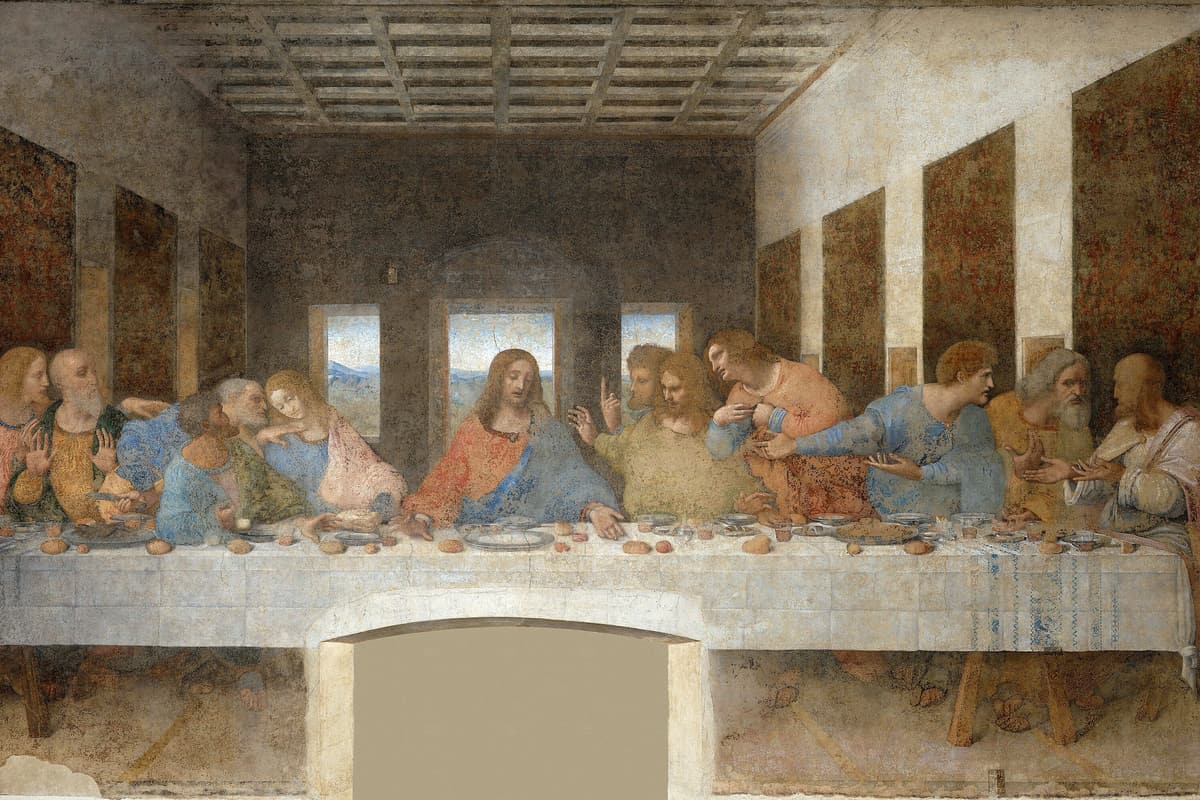
Leonardo da Vinci's Last Supper — Il Cenacolo, or the Cenacolo Vinciano — covers the entire end wall of the refectory of the convent of Santa Maria delle Grazie in Milan. Leonardo painted it between roughly 1495 and 1498 for his patron Ludovico Sforza, Duke of Milan, choosing the dramatic instant when Christ tells the twelve apostles that one of them will betray him and capturing the wave of shock, denial and disbelief that ripples down the table. At 460 by 880 centimetres it is one of the most studied and most reproduced images in the history of art, and it is the reason the entire church and convent of Santa Maria delle Grazie was inscribed as a UNESCO World Heritage Site in 1980.
Leonardo did not paint it in true fresco. Instead he worked in tempera and oil on a dry plaster wall, a method that let him rework details slowly but proved disastrously fragile: the surface began to deteriorate within his own lifetime. Centuries of damp, clumsy over-painting, Napoleonic troops, and a 1943 wartime bomb that destroyed much of the refectory roof all took their toll. The painting survives today thanks to a meticulous restoration that ran from 1978 to 1999, which stripped away the accumulated repaints and stabilised what remains of Leonardo's own hand. To protect that fragile surface, the refectory is now a sealed, climate-controlled environment — and that is the single fact that shapes every visit.
Because the air is so tightly controlled, the museum admits only 40 people every 15 minutes, passing through filtered airlocks, and each group has exactly 15 minutes in front of the painting before the next group enters. That cap — a few hundred visitors a day against demand from all over the world — makes the Cenacolo one of the very hardest tickets to obtain anywhere in Italy. Tickets are released in three-month blocks and a weekly micro-drop, and they routinely sell out within hours.
Every ticket is nominative: it is issued in a specific visitor's full name, and the name cannot be changed once the ticket is bought. On the day you must arrive at the museum ticket office at least 30 minutes before your slot, present the ticket together with a photo ID for the named visitor, and have it validated — only then are you admitted. That is exactly why our service works the way it does: you give us each visitor's name up front, we hold your place on the waitlist, and the moment your date opens we book the ticket in that name so it passes the ID check at the gate.